Professional commercial display solution provider

- Home
-
Products
Professional commercial display solutions
-
About us
In good faith to customers
-
Service
Provide professional and meaningful advice
-
Knowledge Center
Innovation for development
- Contact us
What Is a Custom Display Solution for Commercial Applications?
What Is a Custom Display Solution for Commercial Applications?
A custom display solution for commercial applications is a display system engineered around the specific mechanical, electrical, optical, and environmental requirements of a commercial product or installation, rather than relying on a standard off-the-shelf monitor. A custom solution can include the TFT-LCD module, display interface, driver board, touch panel, cover glass, optical bonding, frame, housing, cables, and other integration components required to create a display that fits the customer's equipment and operating environment.
For commercial applications, choosing the right display is not simply a matter of selecting a screen size and resolution. A display used in a retail kiosk, digital signage system, self-service terminal, public information display, or commercial control system may need specific brightness, viewing angle, interface, dimensions, touch functionality, mounting method, and operating characteristics. A custom display solution addresses these requirements as one integrated engineering project.
Duobond Display specializes in commercial display solutions and provides customizable LCD modules and display integration services for applications including digital signage, retail systems, kiosks, public information displays, and other professional commercial equipment. Its solutions can be developed from individual display modules through integrated display assemblies, depending on the requirements of the project.
What Does a Custom Commercial Display Solution Include?
A custom commercial display solution can consist of multiple hardware and optical components. The exact configuration depends on the application, but the following elements are commonly considered during the design process.
TFT-LCD Module
The TFT-LCD module is the visual foundation of many commercial display systems. It determines important characteristics such as screen size, resolution, viewing angle, brightness, color performance, interface, and mechanical dimensions.
For example, commercial LCD modules available from Duobond Display include 18.5-inch, 21.5-inch, 32-inch and other formats, with different resolutions, brightness levels, and interfaces. Some modules are designed for applications requiring 500 cd/m², 1000 cd/m², or higher brightness depending on the environment.
For an OEM project, the LCD module should be selected according to the complete system rather than screen size alone.
Driver Board
The LCD panel itself does not necessarily provide the video inputs required by the customer's equipment. A driver board can bridge the display module and the host system.
Depending on the project, the display system may require interfaces such as LVDS, eDP, HDMI, DisplayPort, or other signal configurations.
Custom driver-board development or signal conversion can therefore be an important part of a commercial display project. Duobond Display provides driver-board customization as part of its display integration services.
Touch Panel
A commercial display often needs to do more than show information. If customers or operators need to interact directly with the interface, a touch panel can be integrated into the display assembly.
Capacitive touch and resistive touch are common approaches, depending on the application. A kiosk intended for intuitive customer interaction may use a projected capacitive touch panel, while equipment requiring operation with gloves or specific industrial input conditions may require a different touch technology.
Integrating the touch panel during the display design stage can also help control the total thickness, mechanical structure, optical performance, and cable routing of the final product.
Cover Glass and Protection
Commercial displays may be installed in locations where they are exposed to frequent user interaction, accidental impact, dust, fingerprints, or cleaning.
A customized cover glass can therefore provide both protection and a more integrated industrial design.
Depending on the project, the cover glass can be combined with anti-glare or anti-reflection treatments. Optical bonding can also be considered when reducing internal reflections and improving perceived image quality is important.
Custom Frame or Housing
The display module needs to physically fit inside the customer's equipment.
A standard LCD may have excellent specifications but still be unsuitable if its outline dimensions, mounting holes, bezel, connector position, or cable routing do not match the enclosure.
Custom frames and housings allow the display assembly to be designed around the final product.
For example, a commercial kiosk may require a narrow bezel and front-mounted structure, while a retail display may require a completely different mounting configuration.
Cable and Connector Customization
The connection between the display and the main control system can also require customization.
Cable length, connector type, pin configuration, routing direction, and cable position can affect the installation process. For OEM projects, customized cables can reduce unnecessary adapters and simplify final assembly.
Duobond Display lists interface cable customization among its available display engineering services.
Why Do Commercial Applications Need Custom Display Solutions?
Commercial products are often developed around specific industrial designs and operating environments. This makes a universal monitor difficult to use in many OEM projects.
A standard monitor usually has fixed dimensions, fixed mounting points, predefined interfaces, and limited options for integration.
A custom display solution provides greater control over the complete display architecture.
Better Mechanical Integration
A commercial product may have strict limitations on thickness, width, height, and mounting location.
For example, a retail kiosk may have only a specific amount of space available for the screen. A customized LCD assembly can be designed around these physical limitations instead of forcing the enclosure to accommodate an unsuitable commercial monitor.
Better Optical Performance
Brightness requirements vary significantly between commercial environments.
An indoor retail display may work effectively with moderate brightness, while a display installed near a storefront window may require significantly higher luminance.
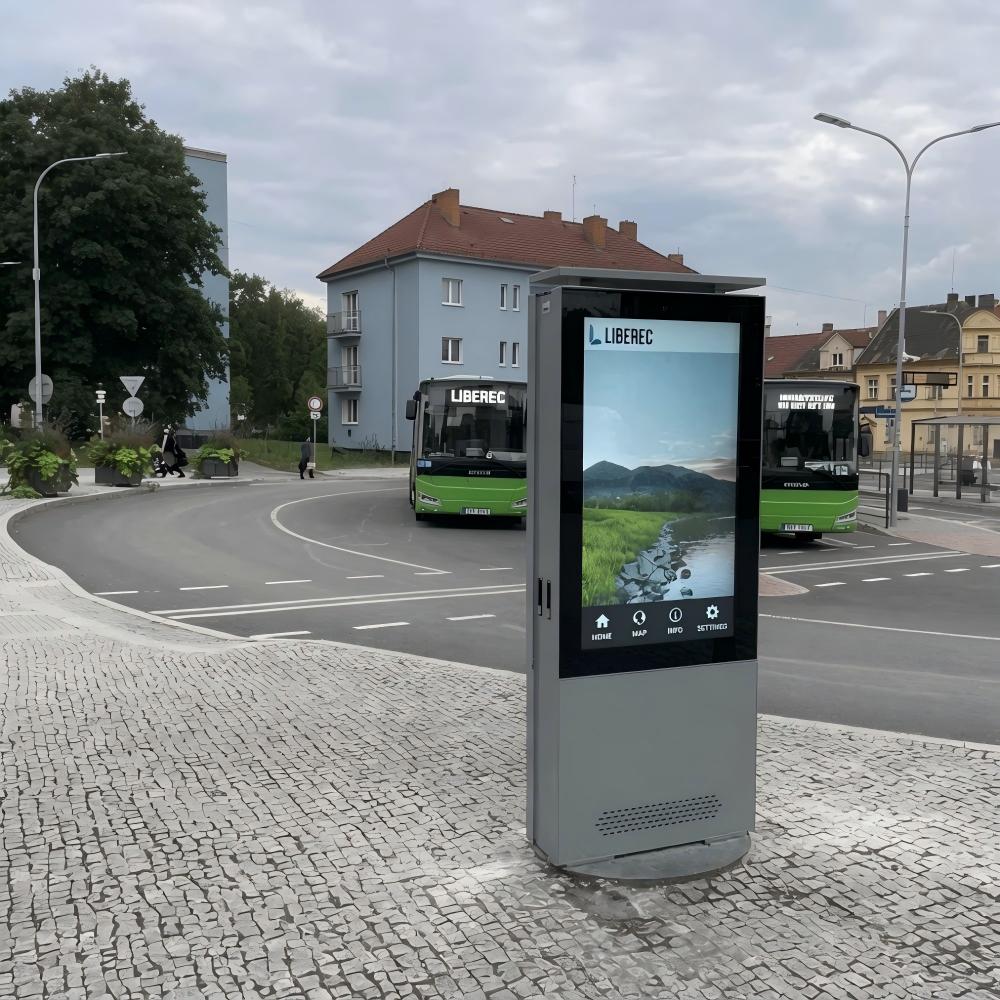
Outdoor commercial displays can require even higher brightness to maintain readability under strong ambient light.
Duobond Display's commercial LCD portfolio includes standard and high-brightness configurations, including LCD modules specified at 500, 1000 and 1500 cd/m² in different models.
The correct brightness should therefore be determined according to the actual installation environment rather than selected simply because a higher number appears better.
Easier System Integration
A custom display solution can combine the LCD module, driver board, touch panel, cables, frame, and other components into a validated system.
This can reduce the engineering work required by the customer because individual components do not have to be sourced and tested independently.
Duobond Display describes this approach as one-stop integration, with pre-tested components intended to reduce compatibility problems and shorten development cycles.
More Consistent Product Design
Commercial products often need a consistent visual appearance across multiple models or screen sizes.
Custom bezels, cover glass, frames, housings, and mounting structures can help manufacturers create a display that visually matches the rest of the product.
This is especially important for branded retail equipment, digital signage systems, self-service terminals, and commercial kiosks.
What Commercial Applications Can Use Custom Display Solutions?
Custom display technology can be used across a broad range of professional commercial equipment.
Digital Signage
Digital signage systems are one of the most common applications.
Retail stores, shopping centers, hotels, transportation facilities, restaurants, and corporate buildings use digital displays to communicate advertising, navigation, promotions, schedules, and other information.
The required display specifications depend on viewing distance, ambient lighting, installation location, content type, and operating hours.
Retail Displays
Retail environments often require displays that fit directly into shelves, advertising fixtures, product displays, kiosks, or checkout systems.
The display may need a customized size or mounting structure rather than a conventional monitor.
For narrow spaces, specialized stretched or bar-type LCDs can also be considered. Duobond Display has developed commercial stretched-display solutions for applications where conventional 16:9 displays cannot efficiently use the available space.
Self-Service Kiosks
Self-service kiosks require both visual output and user interaction.
A typical kiosk display solution may combine:
-
TFT-LCD module
-
Capacitive touch panel
-
Cover glass
-
Driver board
-
Speaker or peripheral integration
-
Custom frame
-
Customized cables
The final configuration depends on the kiosk's operating environment and enclosure.
Point-of-Sale Systems
POS equipment requires clear information presentation in a relatively compact form factor.
A customized display can be designed around the available enclosure while providing the required resolution, brightness, touch functionality, and interface.
Public Information Displays
Transportation hubs, government facilities, commercial buildings, and other public environments use displays for information communication and wayfinding.
These applications often require wide viewing angles and reliable operation because users may view the display from different positions.
Commercial Interactive Displays
Interactive commercial equipment can combine a high-quality LCD module with a touch panel and customized protective structure.
The goal is to create a complete user interface rather than simply installing a monitor inside a machine.
How Do You Choose the Right Custom Display Solution?
The correct display should be selected by evaluating the complete application.
Define the Installation Environment
First determine whether the display will be used indoors, near a window, outdoors, or in another demanding environment.
Ambient light has a major effect on the required display brightness.
Determine the Required Screen Size
Screen size should be selected according to viewing distance, available installation space, user interaction requirements, and the type of content being displayed.
Commercial applications may use everything from compact displays to large-format LCD modules.
Select the Resolution
Resolution should correspond to screen size and viewing requirements.
Full HD remains practical for many commercial applications, while higher-resolution displays can be appropriate when detailed graphics, high-density content, or close viewing distances are involved.
Select the Correct Interface
The display interface must match the host system or driver board.
LVDS and eDP are commonly used for LCD module integration, while HDMI and DisplayPort are often used at the system input level.
If the existing electronics do not directly match the LCD module, a customized driver board or signal conversion solution may be required.
Evaluate Brightness
Brightness should be selected according to the actual lighting conditions.
For example, a 500 cd/m² module may be suitable for many indoor commercial systems, while brighter solutions may be more appropriate for bright storefronts or outdoor applications.
Some Duobond Display modules are available with 1000 cd/m² or 1500 cd/m² brightness for applications with higher ambient-light requirements.
Consider Touch Requirements
If users need to interact with the display, determine whether capacitive or resistive touch is appropriate.
The touch solution should be considered together with cover glass, optical bonding, controller compatibility, and mechanical structure.
Consider Long-Term Availability
Commercial equipment is often produced for several years.
Therefore, display selection should consider not only the initial sample but also long-term supply, production consistency, replacement planning, and engineering support.
This is particularly important for OEM customers developing their own commercial equipment.
What Is the Difference Between a Standard LCD Module and a Custom Display Solution?
A standard LCD module is primarily a display component with defined specifications.
A custom display solution goes further by adapting the display system to the customer's application.
For example, a standard TFT-LCD module may provide a specific resolution, brightness, interface, and mechanical size. A customized solution could combine that module with a driver board, touch panel, cover glass, customized cable, frame, optical bonding, and housing.
Therefore, the difference is not necessarily the LCD panel itself. The difference is the level of engineering and integration surrounding the panel.
This distinction is important for commercial equipment manufacturers because the display is usually one component within a larger product rather than a standalone consumer monitor.
When Should a Business Choose a Custom Display Solution?
A custom display solution is particularly valuable when an off-the-shelf monitor cannot meet the project's requirements.
Businesses should consider customization when they need:
-
A non-standard display size
-
Specific brightness requirements
-
A particular LCD interface
-
Custom cable length or connector configuration
-
Integrated touch functionality
-
Customized cover glass
-
Optical bonding
-
Special mounting dimensions
-
Custom frame or housing
-
High-volume OEM production
-
Long-term product support
-
Integration between the LCD, driver board, and enclosure
In these situations, buying a standard monitor and modifying it later can create additional engineering work and compatibility risks.
A display manufacturer with customization capabilities can instead address these requirements during the design stage.
Why Is TFT-LCD Module Selection Important in a Custom Display Project?
The TFT-LCD module is the core visual component of the final system, so selecting the right module early can prevent costly redesigns.
Important specifications include:
Display size: Determines the physical viewing area and enclosure requirements.
Resolution: Determines image detail and content presentation quality.
Brightness: Determines readability under different lighting conditions.
Viewing angle: Determines how consistently users see the displayed content from different positions.
Interface: Determines compatibility with the system electronics.
Mechanical dimensions: Determine whether the module can physically fit the product.
Operating conditions: Determine whether the display is suitable for the intended environment.
Duobond Display offers a range of commercial TFT-LCD modules with different sizes, resolutions, brightness levels, and interfaces, allowing OEM customers to select a starting platform and then develop additional customization around the display.
For customers looking for a commercial LCD foundation for an OEM or ODM project, the TFT-LCD Module portfolio provides a starting point for selecting the appropriate display technology.
What Makes a Good Commercial Display Solution Supplier?
A suitable supplier should provide more than an LCD panel.
The supplier should understand how the display will be integrated into the customer's equipment and should be capable of supporting the engineering process from component selection through production.
Important capabilities include:
-
LCD module selection
-
Driver board development
-
Touch panel integration
-
Cover glass customization
-
Optical bonding
-
Anti-glare and anti-reflection solutions
-
Cable customization
-
Frame design
-
Housing customization
-
Prototype support
-
Mass-production support
-
Quality control
-
Long-term supply planning
Duobond Display positions its service around this integrated approach, providing customization from display modules to touch, driver boards, frames, cables, and other display components.
Frequently Asked Questions
What is a custom commercial display?
A custom commercial display is a display system adapted to the mechanical, optical, electrical, touch, and environmental requirements of a specific commercial product or installation. It may include a TFT-LCD module, driver board, touch panel, cover glass, frame, housing, and customized cables.
Can a TFT-LCD module be customized?
Yes. Depending on the project, customization can include brightness selection, interface configuration, touch integration, cover glass, optical bonding, cable configuration, driver board development, frame design, and mechanical integration.
What commercial applications use custom LCD displays?
Common applications include digital signage, retail displays, self-service kiosks, POS terminals, public information systems, interactive displays, transportation information displays, and other professional commercial equipment.
Is a custom display better than a standard monitor?
Not necessarily in every situation. A standard monitor can be appropriate when the application has conventional requirements. A custom display becomes more valuable when the product has specific size, interface, brightness, touch, mechanical, or integration requirements.
How do I start a custom commercial display project?
Start by defining the display size, resolution, brightness, viewing environment, interface, touch requirements, mechanical dimensions, operating conditions, estimated quantity, and target application. These specifications allow the display supplier to recommend an appropriate LCD module and customization architecture.
Conclusion
A custom display solution for commercial applications is more than a customized screen. It is an integrated display architecture designed around the requirements of a specific commercial product or installation.
For OEM and ODM customers, the solution may combine a TFT-LCD module, driver board, touch panel, cover glass, optical bonding, customized cable, frame, and housing into one validated display assembly.
The most important principle is to select the display according to the complete application rather than choosing a screen based only on size or resolution. Brightness, interface, mechanical dimensions, touch requirements, viewing angle, environmental conditions, integration method, and long-term supply should all be considered during the design stage.
For commercial display projects that require more than a standard monitor, working with a display supplier capable of both LCD module supply and system-level customization can simplify integration, reduce compatibility risks, and accelerate product development.
Duobond Display provides commercial TFT-LCD modules and customized display integration services to help businesses develop display systems tailored to their specific equipment, environment, and application requirements.
Recommended reading
 2026-06-30What is High Haze Anti-Glare Glass for Advertising Displays?
 2026-06-30Optimizing Display Legibility for Outdoor EV Charging Infrastructure: A Technical Guide to Sunlight-Readable LCD Design
 2026-06-29How Curved LCD Displays Ensure 24/7 Reliability in High-Traffic Gaming Environments
 2026-06-23How Many Nits of Brightness Are Required for an EV Charging Station Display to Be Sunlight-Readable?
 2026-06-23What Touch Technology Is Best for EV Charging Station LCD Displays?

Products
Commercial LCD Display
Gaming LCD Module
Outdoor Display
MINI-LED LCD Display
High Resolution Medical Display
OLED Display
Total Solutions
E-ink LCD Display
Desk VR Monitor
Service
Custom Touch Screen Solutions
Customized Frames & Protective Cover Glass
LCD Driver Board & Accessory Customization
Contact us
Contact Us
Copyright © 2025 Shenzhen Aptus Technology Co.,Ltd All Rights Reserved.

-
Inquire
- Top