Professional commercial display solution provider

How Does High Brightness Impact Display Visibility in Clinical Environments? A 32-Inch 4K Medical LCD Guide
How Does High Brightness Impact Display Visibility in Clinical Environments?
In high-stakes medical environments, the ability to see every critical detail on a display can mean the difference between a successful procedure and a missed diagnosis. Operating rooms, interventional suites, and radiology reading rooms are often flooded with intense overhead lighting — equivalent in glare challenges to direct sunlight outdoors. This is where high brightness and specialized anti-glare technology become game-changers for medical monitors and displays.
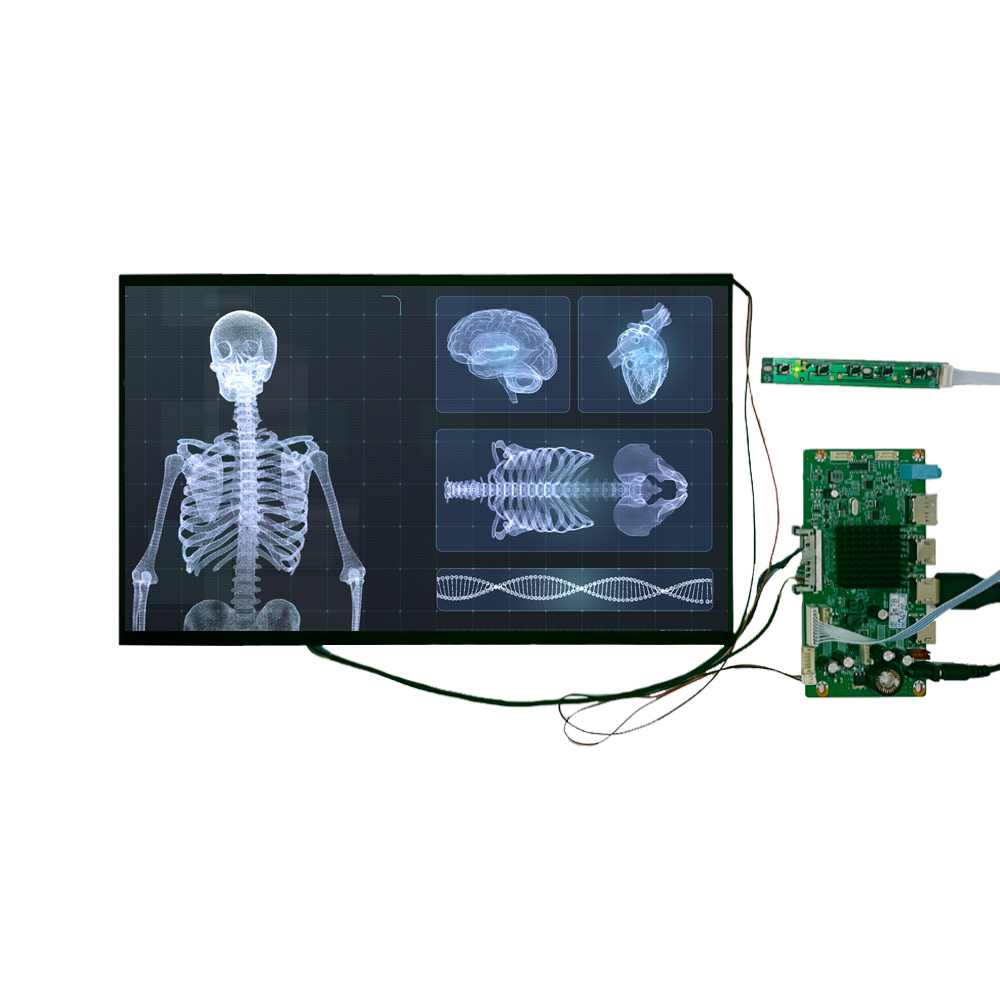
If you’re searching for answers to “how does high brightness impact display visibility,” especially in clinical or healthcare settings, this comprehensive guide (the third article in our four-part series) provides the clarity you need. We dive deep into the science of brightness, contrast, and surface treatments, and we demonstrate why the Precision 32-Inch 4K LCD Module for Medical Equipment (DBT320DZN51E050B) from DuoBond Display is engineered to excel exactly where visibility matters most.
Understanding Brightness in Medical Displays: Why It Matters More Than Ever
Brightness, measured in candela per square meter (cd/m² or nits), determines how well a screen can overcome ambient light and maintain image clarity. In consumer settings, 300–400 cd/m² is often sufficient. In clinical environments, however, surgeons and clinicians face far harsher conditions:
- Operating room lights can exceed 100,000 lux — creating intense specular reflections.
- Overhead surgical lamps and procedure lights generate glare comparable to bright sunlight.
- Multi-person viewing angles and long procedure durations increase the risk of eye strain and reduced visibility.
Medical-grade active matrix LCDs address these challenges by combining elevated brightness levels with advanced optical treatments. Even at a targeted 500 cd/m² — the sweet spot for most surgical and diagnostic applications — a well-engineered panel can deliver exceptional performance when paired with anti-glare coatings.
The DBT320DZN51E050B achieves precisely this balance. Its 500 cd/m² typical brightness, combined with a 1500:1 contrast ratio and 25% haze anti-glare surface (3H hardness), ensures that high-resolution 4K imagery remains sharp, vibrant, and readable under the most demanding lighting conditions.
How High Brightness Directly Improves Visibility: The Technical Breakdown
- Overcoming Ambient Light and Glare Higher brightness increases the luminance output, allowing the display to “punch through” reflections. In an OR, where surgical lights can wash out lower-brightness screens, 500 cd/m² provides sufficient headroom so that surgeons never lose sight of fine vascular structures or tissue margins during laparoscopic or robotic procedures.
- Maintaining Contrast Ratio in Real-World Conditions True visibility isn’t just about raw brightness — it’s the ratio of brightest white to darkest black (contrast). The DBT320DZN51E050B preserves its 1500:1 contrast even under bright illumination, ensuring subtle grayscale differences in X-rays, CT scans, or live endoscopic feeds remain distinguishable.
- Anti-Glare Coating Synergy The module’s 25% haze treatment diffuses specular (mirror-like) reflections without introducing excessive sparkle or reducing sharpness. This is far superior to untreated glossy panels that turn into mirrors under OR lights. The result: surgeons can maintain optimal viewing positions without constant adjustment, reducing fatigue during procedures that can last several hours.
- Color Accuracy and Uniformity Under Light With support for 16.7 million colors (True 8-bit) and 10-bit input via FRC, the panel delivers lifelike tissue tones even when brightness is pushed to combat ambient light. Backlight uniformity remains excellent across the 32-inch (697.3056 × 392.2344 mm active area) panel, preventing hot spots that could distract during critical moments.
- Response Time and Motion Clarity At 14 ms optical response, the active matrix TFT design prevents smearing in dynamic surgical video, ensuring that high brightness doesn’t come at the cost of motion blur.
Industry studies and clinical feedback consistently show that properly implemented high-brightness medical displays improve procedural efficiency, reduce cognitive load on surgeons, and enhance diagnostic confidence in radiology workflows.
Real-World Application Scenarios: High Brightness in Action
1. Operating Rooms and Minimally Invasive Surgery During laparoscopic cholecystectomy, arthroscopy, or robotic prostatectomy, the 32-inch 4K format combined with 500 cd/m² brightness and anti-glare lets the entire surgical team view the endoscopic feed clearly. Picture-in-picture overlays of vital signs and preoperative imaging remain legible even when strong overhead lights are positioned directly above the console.
2. Interventional Radiology and Hybrid ORs In fluoroscopy-guided procedures or C-arm suites, where lighting conditions change rapidly, the module’s brightness ensures continuous visibility of guidewires, catheters, and contrast-filled vessels without the need to dim room lights excessively.
3. Radiology and PACS Workstations Although diagnostic rooms are typically dimmer, many modern reading rooms incorporate brighter ambient lighting for collaboration. The panel’s performance supports accurate interpretation of high-resolution CT, MRI, and mammography studies, with the anti-glare surface preventing window or lamp reflections from degrading image quality.
4. Emergency Departments and Mobile Carts Portable ultrasound or anesthesia carts often operate under varying and unpredictable lighting. The low-power (12.98 W typical at 60 Hz) yet bright design makes the DBT320DZN51E050B ideal for these mobile medical displays.
5. Medical Training and Simulation Labs Simulation centers recreate realistic OR lighting. Trainees benefit from the same high-visibility experience they will encounter in actual procedures, accelerating learning curves.
Comparing Brightness Levels: What’s Right for Medical Use?
While some ultra-high-brightness surgical monitors reach 1000–2000 cd/m² for extreme outdoor or hybrid OR use, 500 cd/m² strikes the optimal balance for the majority of clinical applications. It delivers sufficient visibility without excessive power consumption, heat generation, or shortened backlight life. The DBT320DZN51E050B’s LED backlight is rated for up to 30,000 hours, supporting cost-effective, long-term deployment in busy hospitals.
Frequently Asked Questions (FAQ)
Q1: Does higher brightness always mean better visibility in clinical settings? Not alone. Optimal visibility requires the right combination of brightness, contrast ratio, and anti-glare treatment — exactly what the DBT320DZN51E050B provides.
Q2: How does 500 cd/m² compare to sunlight-level brightness? It is more than adequate for OR lighting conditions (often equivalent to bright sunlight glare). The anti-glare coating makes the effective usable brightness even higher in real-world use.
Q3: Will anti-glare coating reduce image sharpness? No. The 25% haze treatment on this module is carefully calibrated to diffuse reflections while preserving excellent sharpness and color fidelity.
Q4: Is this 32-inch 4K medical display suitable for bright operating rooms? Yes — its 500 cd/m² brightness and specialized surface treatment are specifically designed for high-illumination clinical environments.
Q5: How does brightness affect eye strain during long procedures? Proper brightness levels reduce the need for surgeons to strain to see details, lowering fatigue and improving focus over extended surgical times.
Q6: Can the module be used in both bright and dim clinical environments? Absolutely. Its wide dynamic range and stable performance adapt seamlessly to varying lighting conditions.
Q7: What is the power impact of running at full brightness? The DBT320DZN51E050B remains highly efficient at only 12.98 W typical, even when delivering its full 500 cd/m² output.
Conclusion: High Brightness Is the Key to Uncompromised Clinical Visibility
High brightness is not a luxury — it is a fundamental requirement for medical displays operating in challenging lighting conditions. When paired with anti-glare technology and medical-grade engineering, it transforms how clinicians see, interpret, and act on visual information.
The Precision 32-Inch 4K LCD Module (DBT320DZN51E050B) proves that 500 cd/m², when expertly implemented, delivers outstanding visibility, reliability, and integration ease for today’s demanding healthcare environments.
OEM manufacturers, hospital procurement specialists, and systems integrators seeking a high-performance medical display that excels under bright clinical lighting will find this module to be the ideal solution.
Experience the difference high brightness and anti-glare technology can make. View full specifications and integration details for the Precision 32-Inch 4K LCD Module for Medical Equipment
Continue the Series:
Recommended reading
 2025-12-29Commercial LCD Display Industry Trends and Market Insights for 2026
 2025-12-23Why Custom Commercial Displays Are Becoming Standard in Modern Systems
 2025-12-17Advancing Outdoor Visual Systems with High-Brightness, Wide-Temperature LCD Technology
 2025-12-10Outdoor Commercial LCD Modules for Wide Temperature High-Brightness Advertising Displays
 2025-12-0215,6-Zoll 4K Medical Display Module für hochpräzise diagnostische Bildgebung


Products
Commercial LCD Display
Gaming LCD Module
High Resolution Medical Display
Outdoor Display
E-ink LCD Display
Desk VR Monitor
OLED Display
Total Solutions
Service
Custom Touch Screen Solutions
Customized Frames & Protective Cover Glass
LCD Driver Board & Accessory Customization
Contact us
Contact Us
Copyright © 2025 Shenzhen Aptus Technology Co.,Ltd All Rights Reserved.

-
Inquire
- Top